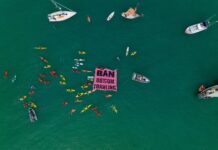
We were sailing on the Gulf north of Waiheke on Saturday, ghosting along with the faintest of afternoon sea breezes riffling the eastern horizon and an ocean that might never have known known a swell in all its history, when it occurred to me that we were sailing diagonally across the territory for Waiheke’s proposed 2,350 ha Hākaimangō – Matiatia Marine Reserve.
By coincidence, since we were following no planned track, my fellow crewman had spent the previous day hiking around the headlands in front of us and had noticed the swirls of dense kelp forest around the tidal rocks below the track.
Everyone knows the Gulf is in crisis, as the Hauraki Gulf Forum’s State of the Gulf limp-wristed reports continue to document. We know that no-take marine reserves are a proven way to restore healthy biodiversity and are not a threat to fishers.
That particular piece of the Gulf was chosen precisely because it had the highest level of original kelp forest left.
Instead commercial interests are pushing forward in spite of two decades of extinctions and dire outcomes for fish stocks and other marine life.
The Waiheke site for a no-take reserve like that already established at Leigh would regenerate the benthic mass far beyond the bounds of the designated reserve and be a far better way of helping nature repel the villainous caulerpa seaweed that is colonising the Gulf’s kina barrens. Of course it is. That’s what plague species do when nature finds a vacuum.
Public submissions closed for the marine reserve on the northern coastline in 2022 with 88 percent of them in favour but it still awaits ministerial approval. Or the approval of those others who matter in Wellington.
It seems as if modern man, at this crux of scientific western civilisation, has forgotten that we live in a closed system where there are consequences, even, eventually, for the wealthy and sorted.
In any case, squabbling over who owns any piece of land is like two fleas arguing over who owns the dog, as the sapient Mick said in the first Crocodile Dundee movie when explaining the Outback and aboriginal concepts of property to his city-bred Girl Friday.
Civilisations long before ours knew and honoured the balance of nature and the need to conserve both hunted animal prey and the habitat that provided that bounty in harmony with nature. From which, of course, absolutely everything devolves.
Gratitude and formal reciprocity for nature’s abundance was sewn into the DNA of agrarian and coastal societies and Lewis Hyde, in his seminal 1979 book The Gift: How the Creative Spirit Transforms the World reprises the effectiveness and dynamism of gifting as a social phenomenon and a fine-tuned reciprocity that includes the Māori traditions of hau.
Translated as spirit, in the context of hunting rituals in which the hunters pass the gift to tohunga who, after a ceremonial whāngai hau to feed the essence, passed it back to the forest, which would ensure good future hunting and the tribe’s food sources to retain their vigour.
Honour was central to tribal life and similar traditions existed where there was a strong component of community life. Hyde studied tribal families on the salmon fishing river mouths of western California north to Alaska which had a highly developed ‘potlatch’ – from the Chinook word ‘patshall’ which means ‘gift’ or ‘to gift’ – which was a vast communal feast that might involve years of planning. For obvious reasons, the colonists soon outlawed them.
Potlatch distribution was a massive gifting and sometimes the host family was left with very little wealth. However, a strict honour code and reciprocal gifting to the same value as the original gifts – typically food, blankets, coppershields, cedar bark or cattail mats, canoes or carved items and intangible property such as names, dances, songs, legends and chants – meant the host family was soon wealthy again and wealth was circulated through the tribal families.
By comparison, modern capitalist societies, however richly endowed, dedicate themselves to the proposition of scarcity, according to Americal cultural anthropologist Marshall Sahlins. “Inadequacy of economic means is the first principle of the world’s wealthiest peoples.
“The market-industrial system institutes scarcity, in a manner completely unparalleled and to a degree nowhere else approximated.
“Where production and distribution are arranged through the behaviour of prices and all livelihoods depend on getting and spending, [introduced] insufficiency of material means becomes the explicit, calculable point of all economic activity.”
Our predecessors, and our successors, would be appalled at the crudeness of our over-entitlement over these last four centuries of conquest and empire and the current end-game of capitalism which counts as an all-out war on a bountiful nature that provided everything we have ever known or made or used on the face of the Earth.
Nature’s health is not an optional extra.
• Liz Waters